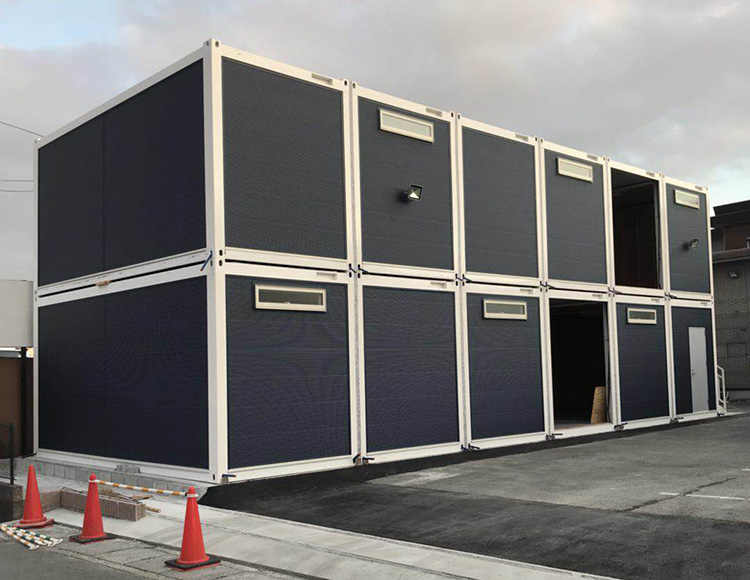
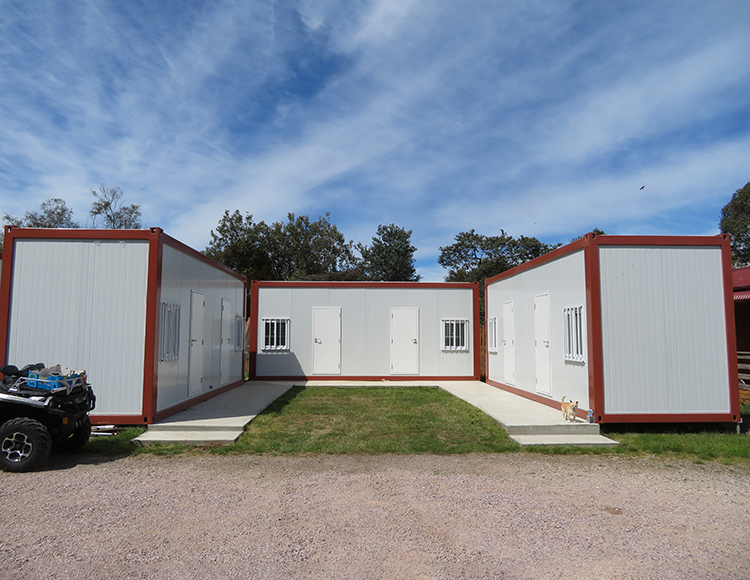
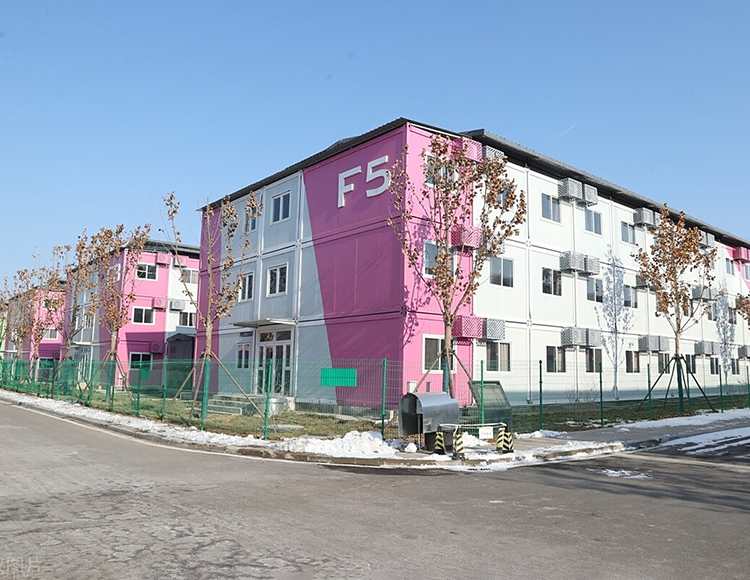
Beijing WanJinLong Color-Coated Steel Products Co., Ltd.

20 years focus on Container houses!
Excellent Quality & 7x24 hours Aftersales Service
Tel & WhatsApp:+8617611653912
Beijing WanJinLong Color-Coated Steel Products Co., Ltd.
20 years focus on Container houses!
Excellent Quality & 7x24 hours Aftersales Service

Technology
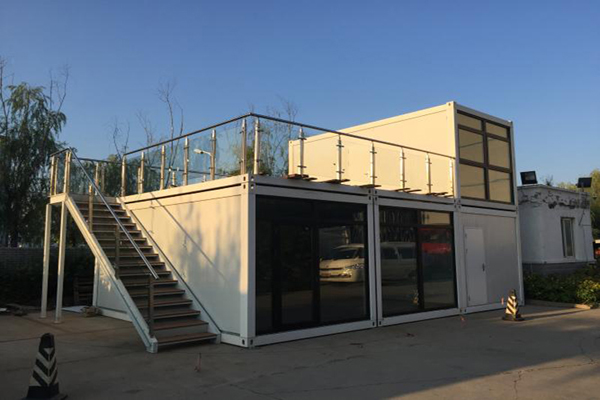
The architectural design standards for steel structure container houses should be based on the features of module integration and combination diversity.Steel Structure Modular Container HouseBuilding...
Tel & WhatsApp:+8617611653912
Product Details
The architectural design standards for steel structure container houses should be based on the features of module integration and combination diversity.
Steel Structure Modular Container House
Building Composition
1. Outline
1.1 A steel structure modular container house is a building system that utilizes a steel frame integrated with wall panels. All modular components are standardized and prefabricated, enabling rapid on-site assembly via standardized connectors. The design and construction of this modular building system adhere to the principles of generalization, modularization, industrialization, and optimized integration.
1.2 The modular container house is composed of container-sized unit modules designed for residential and commercial use. Each unit module primarily consists of a roof, floor, columns, walls, doors, windows, and fittings. These components are manufactured to precise tolerances in the factory, ensuring fast and accurate on-site installation.
1.3 The container houses feature a standardized design. Their flat-pack configuration facilitates cost-effective transportation and efficient storage. The structures can be disassembled and reassembled multiple times, offering a reusable, energy-efficient, and eco-friendly building solution.
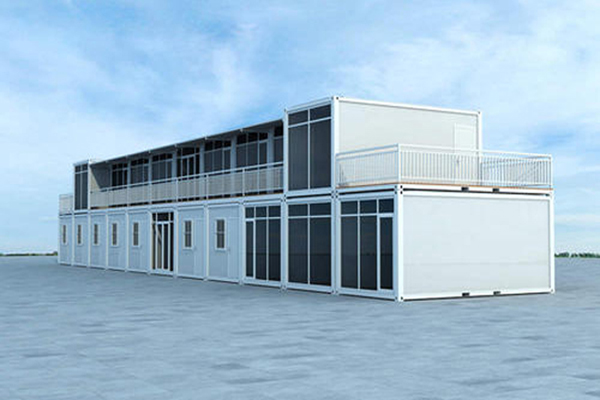
1.4 The container houses allow for flexible spatial arrangements. In addition to horizontal and vertical connections, the units can be stacked and integrated with mezzanine platforms. Internal partitions and walls can be flexibly configured within the interconnected space.
2. Application Scope
2.1 This standard applies to the design of container houses with three stories or fewer.
2.2 It is suitable for the design and construction of temporary or relocatable housing projects, including those for hotels, campsites, tourist attractions, military camps, construction site offices, kiosks, villas, and retail shops.
3. Design Key Points
The architectural design of steel structure modular container houses shall comply with the principles of modular coordination, configuration diversity, and functional practicality. The design shall ensure efficient space utilization and facilitate construction, meeting the following requirements based on the project's operational characteristics.
3.1 Provide a rational use function and convenient spatial layout.
3.2 Meet functional requirements for skylights, lighting, ventilation, sound insulation, thermal insulation, waterproofing, and sanitation.
3.3 Comply with safety requirements for fire prevention, evacuation, and protection.
3.4 Fulfill energy-saving and environmental protection standards.
3.5 For selected engineering designs, structural calculations can be performed based on the load-bearing capacity data for individual containers and their connections, as provided by the manufacturer.
3.6 Architectural and structural designs shall be coordinated. Openings in wall panels or large cantilevered arrangements on the container body must meet structural safety requirements.
3.7 Equipment and pipelines shall be anchored and fixed to the metal structure of the container house. Internal equipment and pipelines shall be pre-designed and pre-installed alongside the interior finishing works, with system installation finalized on site.
3.8 The durability of externally pre-installed pipelines shall meet engineering requirements and be protected against water, corrosion, and impact.
3.9 The floor plan, spatial layout, and composition of the container house shall accommodate the installation and maintenance of pipelines.
3.10 If equipment risers need to pass through the roof or floor structure of the container house, openings shall be pre-positioned. The hole diameter shall account for installation tolerances, and the sealing shall meet fireproof, waterproof, and sound insulation requirements.
3.11 The electrical distribution system of the container house shall utilize the integrated steel structure for main equipotential bonding. The external interface of a small container house shall be equipped with a dedicated socket, the rated current of which shall comply with specifications.
3.12 Grounding systems, including operational grounding, PEN conductor repeated grounding, lightning protection grounding, and grounding for weak current equipment, shall adopt a "common grounding system." The inherent steel components and foundation reinforcement shall be used as a joint natural grounding body, with a grounding resistance not exceeding 1Ω. Equipment with special grounding requirements may be provided with a separate manual grounding body.
3.13 During the construction of container houses, the principles of environmental protection and energy conservation shall be applied to all aspects, including materials, design, and construction. It is advisable to rationally adopt energy-saving, water-saving, material-saving, and land-saving technical measures, such as utilizing new resources, energy-efficient lamps, composite walls, and sunshades, to achieve an integrated design.
3.14 A structural analysis shall be conducted for various conditions the container house may experience after assembly, such as lifting, transportation, and stacking. Measures shall be taken to address potential relative deformations of various components.
4. The content and introduction of container house
4.1 The basic module of the steel structure modular container house is a single unit. We also provide functional modules such as stairs, restrooms, and shower cubicles to meet the fundamental operational needs of the building. A variety of spatial layouts are formed by splicing these energy-efficient modules together in different configurations.
4.2 Common basic modules are divided into two specifications: the 6030 type and the 6024 type.
Item | Type | ||
6030 type | 6024 type | ||
Outside dimensions(mm) | Length | 6055 | 6055 |
Width | 3000 | 2435 | |
Height | 2896 | 2896 | |
4.3 Composition of Steel Structure Modular Container House
The steel structure modular container house is primarily composed of the following components:
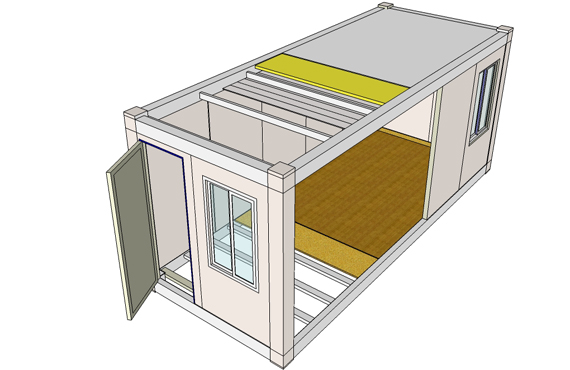
Roof Assembly
Comprises roof beams, top corner fittings, capping plates, insulation material, top C-purlins, ceiling panels, and electrical conduit boxes.
Floor Assembly
Consists of floor beams, bottom corner fittings, sealing color sheets, insulation material, bottom C-purlins, structural decking, finished flooring, and drainage channels.
Column System
Includes corner posts, L-angle connectors, intermediate column members, and insulation materials.
Exterior Walls
Two configuration options available:
Metal-faced insulated sandwich panels with standard thickness of 75mm (100mm optional)
Lightweight stud wall with composite insulation using 50mm and 75mm boards
Key structural sections and thermal performance parameters are detailed in Table 1.
Interior Partitions
Two configuration options:
Metal-faced insulated sandwich panels (75mm standard, 100mm optional)
Lightweight stud wall system
Doors
Multiple options available per Table 2:
Steel doors, thermally broken aluminum alloy doors, plastic-steel doors, aluminum-magnesium alloy doors, and wooden doors.
Windows
Select from options in Table 2:
Plastic-steel windows or thermally broken aluminum alloy windows.
Roof Structures
Available in either:
• Metal-faced insulated sandwich panel sloped roofs
• Traditional tile roofing systems
Supporting Components
Includes outdoor staircases, access walkways, guardrail systems, and protective canopies.
Ancillary Parts
Comprises electrical accessories, decorative trims, assembly kit components, and LCL (Less than Container Load) fitting packages.
Related Articles